Invasive Exotic Plants
For Florida an invasive exotic plant is a species introduced to the state, purposefully or accidentally, from a natural range outside the state that has naturalized and is expanding on its own in Florida native plant communities. Some invasive exotics spread aggressively and can pose a significant threat to native species. The Florida Exotic Pest Plant Council has identified the most invasive ones (https://www.floridainvasives.org/plant-list/2023-invasive-plant-species/), and the Forest Service tries to control these and to limit opportunities for invasion (3-23; USDA FS 1999).
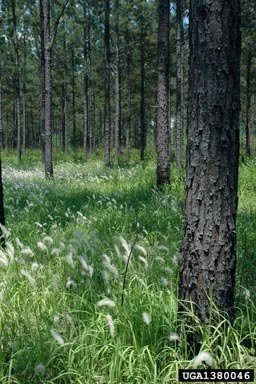
Only 11 of the 91 species listed in the list of invasive plants that occur in north Florida (C-3; USDA FS 1999) have been documented to occur on ANF (Table 1) and an additional 28 species are possible but have not been documented (Table 2). For example, coral ardesia (Ardesia crenulata) is not listed on the plant list for ANF, but it undoubtedly occurs there. Japanese climbing fern (Lygodium japonicum) and cogongrass (Imperata cylindrica) are likely the most common invasive exotic plants in Apalachicola National Forest.
For Florida an invasive exotic plant is a species introduced to the state, purposefully or accidentally, from a natural range outside the state that has naturalized and is expanding on its own in Florida native plant communities. Some invasive exotics spread aggressively and can pose a significant threat to native species. The Florida Exotic Pest Plant Council has identified the most invasive ones (http://www.fleppc.org/list/11list.html), and the Forest Service tries to control these and to limit opportunities for invasion (3-23; USDA FS 1999).
Only 13 of the 60 species listed in the list of invasive plants (C-3; USDA FS 1999) have been documented to occur on ANF (http://www.friendsofanf.org/#!checklists/c16zl), but that does not mean that more species do not occur on the forest. For example, coral ardesia (Ardesia crenulata) is not listed on the plant list for ANF, but it undoubtedly occurs there. Japanese climbing fern (Lygodium japonicum) and cogongrass (Imperata cylindrica) are likely the most common invasive exotic plants in Apalachicola National Forest.
L. japonicum is probably scattered over much of the forest in many mesic conditions, but infestations are widely separated and mostly small except along the floodplain of the Apalachicola River and perhaps the Ochlochonee River. Lygodium is definitely an important invasive exotic plant, especially in rich, low areas, such as river floodplains, however, it may be more difficult to eradicate and keep off public lands because: not only is it difficult to kill, but re-infestation is so likely.
I. cylindrica is known along FH13, mostly on the Wakulla Ranger District but there are some small infestations along FH13 west of the Ochlockonee River. This may be a particularly critical infestation, because it could result in off-road infestations along several miles of roadway. There is a known infestation approximately 6.5 miles north of FH13 on the east side of SR 65. There was a small infestation on FR 180 that may have been eradicated. There are also infestations on the newly acquired land on FS 180 (formerly owned by St. Joe Development Co.), and just south of Little Owl Creek on the east side of Route 379. Most of these infestations have been treated with varying degrees of success over the past few years. There are several infestations in the northeast part of the Wakulla Ranger District, some on private land. There is also a heavy infestation at the Telogia Power Plant that may have been treated, but not likely eradicated. The presence of this species is a threat to the forest, because the plant spreads quickly, is difficult to eradicate, and tends to dominate other ground cover species.
Recommendations:
Surveys should be conducted to detect new or unknown infestations of invasive exotic species as well as have all FS staff trained to recognize these and other exotics so they will be able to detect and report infestations.
All known infestations should be inspected frequently. Any remaining plants should be treated promptly.
Private landowners with infestations near the Forest should be contacted and arrangements made to have those infestations treated.
The Friends, as well as other landowners, can play a vital role by reporting observed infestations, by checking known infestations to make sure they are being aggressively controlled/eradicated by timely treatments and follow-up treatments, and by encouraging the FS to eradicate all know infestations, especially those of Imperata cylindrica.
Literature Cited
USDA Forest Service. 1999. Revised Land and Resource Management Plan for National Forests in Florida. Management Bulletin R8-MB-83A.
VG-37 – Control invasive terrestrial and aquatic weeds. If herbicides are used, apply directly on the spot. Do not apply herbicides within 60 feet of any PETS plant species unless analysis indicates herbicide use is the best way to protect PETS plants from invasive weeds.
VG-38 – Plant only native species—except nonnative (noninvasive, nonnoxious) species may be planted in wildlife plots, in developed recreation sites, in administrative sites, or for erosion control. Do not plant species capable of invading adjacent land. Use Bahia grass (Paspalum notatum) where it is the only practical solution.
VG-39 -- When a project requires mulch, require that the mulch come from a source that is apparently free of invasive weeds or their seeds. Hay taken from a roadside may not be weed-free.